


Mistral AI is one of the first AI companies to conduct a comprehensive life cycle assessment (LCA) of its language models. The study, conducted in collaboration with Carbone 4 and the French environmental agency ADEME, marks an important step toward transparency regarding artificial intelligence's environmental impact.
The French startup, which has only existed for 18 months, has broken new ground with this initiative: Until now, there have been no comparable detailed analyses of the environmental impact of AI models across their entire life cycle.
The concrete figures
Mistral Large 2: The overall balance
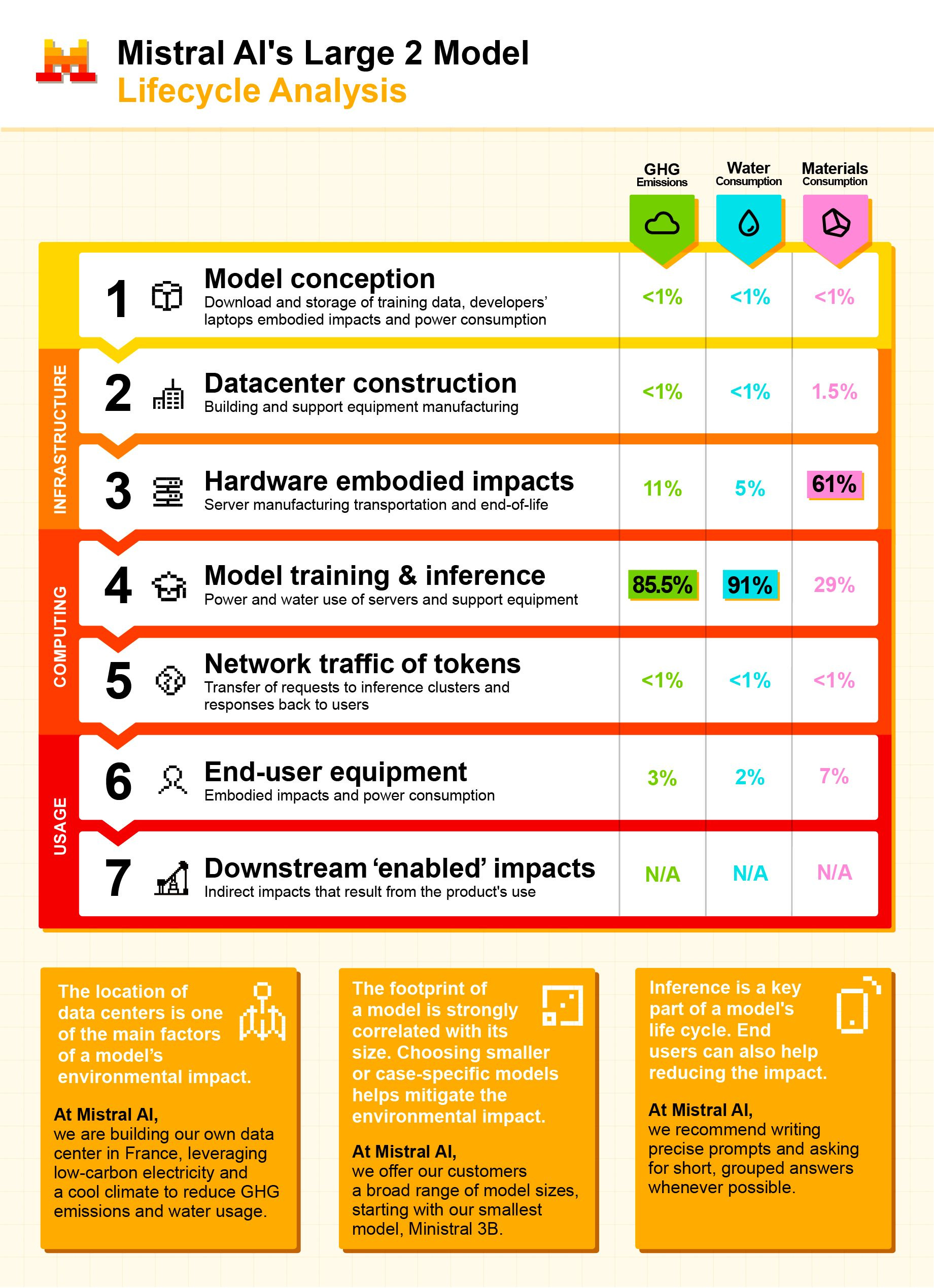
After 18 months of use, the Mistral Large 2 model caused the following environmental impact:
20.4 kilotons of CO₂ equivalents (ktCO₂e)
281,000 cubic meters of water consumption
660 kg antimony equivalents (Sb eq) for resource consumption
The individual prompt: Small but significant in large numbers
The figures for individual queries are particularly revealing:
1.14 grams of CO₂ emissions per average query
45 milliliters of water consumption per query
These figures may seem negligible at first glance. However, the challenge lies in the sheer volume: billions of queries add to a significant environmental impact.
Classification in the digital context
To better understand these figures, it helps to compare them with other digital activities:
A Google search generates about 0.2 to 1 gram of CO₂
An AI query is, therefore, somewhere between a Google search and a long email. However, AI systems are often used for more complex tasks that would previously have required multiple searches or other activities.
Key findings
1. Model size is crucial
The study shows a direct correlation between model size and environmental impact: a ten times larger model causes about ten times higher emissions for the same number of tokens generated. This underscores the importance of choosing the right model for specific use cases.
2. Training vs. usage
The environmental impact is spread across two main phases:
Model training (one-time but intensive phase)
Inference (ongoing use by users)
The ratio between these two phases is an important indicator of whether the training phase is used efficiently.
3. Three key indicators
Mistral proposes three key metrics:
Absolute CO₂ impact of training
Relative CO₂ impact of inference (the generation of text based on the trained models)
Ratio of inference costs to total CO₂ footprint over the entire life cycle
Critical consideration
Methodological challenges
The study itself acknowledges that this is a “first approximation.” Several factors make precise calculations difficult:
Lack of standards for environmental accounting of AI systems
Lack of publicly available data on environmental impacts
Incomplete data on GPU manufacturing and its environmental impact
Lack of industry-wide transparency
While Mistral's initiative is commendable, the AI industry lacks transparency. Most major providers do not publish comparable data, which makes it difficult to make informed comparisons and conscious decisions.
Are scaling effects underestimated?
The study focuses on a single model. The cumulative effects of a growing number of AI models and their exponentially increasing use are not sufficiently addressed.
Recommendations for action
For companies and developers
Mistral proposes concrete measures:
Publication of standardized environmental reports
Development of industry-specific standards
Creation of an evaluation system for AI models
For users
Users can also contribute to reducing environmental impacts:
Conscious model selection based on actual requirements
Bundling of requests to avoid unnecessary calculations
Development of AI expertise for optimal use
For politics and administration
Public institutions should integrate model size and efficiency into procurement criteria to create market incentives for more sustainable AI development.
Conclusion
Mistral's environmental study is an essential first step toward greater transparency in the AI industry. The published figures show that while individual AI queries have a relatively low environmental impact, the overall effect of billions of queries is significant. In particular, with the currently very popular vibe coding, the number of queries and the context size add up quickly, which users increasingly see in their bills.
At the same time, the initiative highlights the urgent need for industry-wide standards and comparable metrics. Users and companies can only make informed decisions when all providers publish similar data.
It is important to note that the study has methodological limitations and may underestimate the long-term scaling effects of AI use. Nevertheless, Mistral is sending an important signal to the entire industry with this publication.
The challenge is translating these initial findings into concrete industry standards and sustainable practices before the exponential growth in AI use becomes a serious environmental problem.